
The consultant goes home. The colleagues stay.

8 min. read

After nearly 20 years as a crisis psychologist and leader at organizations including the Danish Red Cross, the Danish Cancer Society, the Danish Defence, and Mental Health Services in the Capital Region of Denmark, Rikke Høgsted became self-employed. She brought with her a professional curiosity: Why do psychological strain so easily become a matter for the individual, when we know how much both the demands, the working conditions, and the community matter?


That curiosity became The Basic Book on Strain Psychology, followed by several more books and, in 2020, the first Digital Foundation Course. Today, the courses have moved to the new MentiMove platform.


We asked Rikke what actually happened along the way.


If we go back to the beginning: What was it that you wanted to change?

I was concerned about how easily psychological strain can become individualized.


If a professional falls down a staircase at work and gets injured, we would examine the staircase. How is it designed? Is it too steep? Is the surface slippery? Is there a handrail? We look for factors that can help explain the accident and help us prevent it from happening again.


When a professional experiences psychological injury, we quickly turn our attention to the individual. Why did she react so strongly? Is there something in her personal life that plays a role? Was she already carrying something with her?


It’s strange, because we have known for a long time that everyone has a breaking point. We learned a great deal about this during World War II, among other things. Psychological strain is largely a matter of dose and response: What are we exposed to, what demands are we facing, how intense are they, and how long do they last? And it is crucial how we are met and supported by others when something happens, and what conditions the workplace provides around us.


This is particularly important in the professions I have worked with throughout my career. In these fields, professionals encounter serious illness, violence, accidents, death, neglect, and people in deep crisis as part of their work. We need these people. That is why we need to do our very best to prevent psychological strain and to make sure we support people properly when something happens.


And that became The Basic Book on Strain Psychology?

Yes. I had actually imagined that I would write a small, disarming little book. It didn’t quite turn out that way. It became The Basic Book on Strain Psychology and later several more books. A book could gather and communicate knowledge, but the question was how that knowledge could make a difference to what happened at 2 p.m. on a Tuesday in a workplace.


I travelled across the country with good colleagues, delivering courses and training programmes in Strain Psychology. It became increasingly clear to us that something important happened when professionals recognized their own reality in the material and began talking about it together. It is one thing to read about the theory of psychological strain, warning signs, and prevention strategies. Something else happens when you sit down with your colleagues and suddenly realize: “Oh, we know that. That actually happens here.”
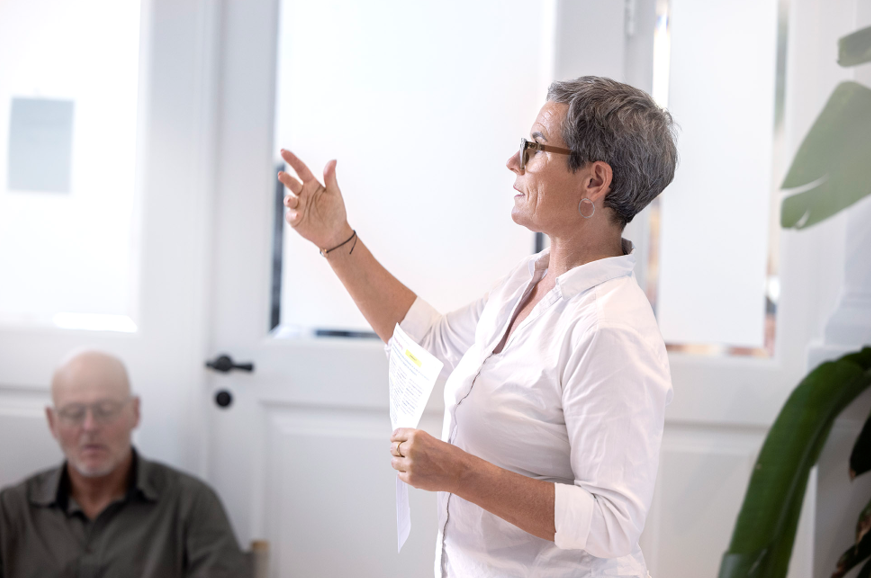
From the years of delivering courses and training programmes at workplaces.


So where did the idea for a digital foundation course come from?

We had actually already tried out the idea of using short films together with the Danish Prosecution Service. We had made films for a theme day for prosecutors across the country – another professional group whose work involves significant psychological demands – and could see that the films worked well as a starting point for shared conversations.


And then COVID hit! It was almost like being sent back to the starting square in the Ludo game of working life. Or perhaps, more accurately, sent straight to jail! All of us who were used to travelling across the country and meeting people at their workplaces were suddenly grounded at home.


But as the saying goes, necessity is the mother of invention. So we took what we had learned from the films and the knowledge in the book, and got to work.

We put the foundation book on the digital grid

In late summer 2020, the first Digital Foundation Course was launched. Short films presented the material, and between the films, participants talked together about what they had seen and related it to their own everyday work. This meant that we could still provide the professional knowledge, even though we could not be physically present. But the workplaces themselves had to take responsibility for what happened between the films. At first, it was primarily a practical solution to a rather unusual situation.


The digital format was therefore initially a response to a very specific problem. But over time, we discovered that it could do something we had never anticipated.


What was it that you discovered?

We discovered that something different happened in the room when we weren’t the ones standing in the middle of it. An external trainer can share knowledge, ask questions, challenge and inspire. And of course, that can be both important and necessary. But an external trainer does not know the workplace in the same way as the people who are there every day.

The consultant goes home again. The colleagues stay.

And it is the colleagues who know the patients, citizens, customers, and tasks. They know exactly what happens at 2 p.m. on a Tuesday, when the phones are ringing off the hook, a colleague is off sick, and a difficult conversation is waiting. They know their own culture, their shortcuts and blind spots. They know what usually works, and what perhaps doesn’t. And they will still be there the next day, when something needs to be done differently.


That was when we recognized something that has since become fundamental to the way we think.


We thought we had primarily found a new way of sharing knowledge. But in workplaces, we could see that something more was happening. They rolled up their sleeves and got to work themselves.

Competence and culture cannot be outsourced.

Workplaces become stronger by doing the work themselves. Others cannot do it for them, because they are the ones who shape and live their culture. That does not mean workplaces have to come up with everything themselves. Not at all. Our role is to design the frameworks, tools, and shared professional foundation that they can build on. We cannot do the actual translation into their own reality for them.


I sometimes describe us as an IKEA company. We have designed it and found good materials and tools. Now the workplace has to put it together themselves. Along the way, they may discover that it needs to be arranged a little differently for them. Maybe they come up with a hack we would never have thought of ourselves. That way, they get both the finished product and the experience of building on it themselves. The most important thing happens when professionals continue working with the material together.


But is it enough simply to give the workplace the materials and let them get started?

No. Because that is something we have become much wiser about along the way. Even the best course material does not do much on its own if it stands alone. There needs to be a plan for how the courses are used, and someone needs to keep the process going.


Along the way, we began asking a bigger question: How can something that starts with a course become part of an ongoing process? Because the work of prevention does not end just because you have completed a course. Workplaces are constantly changing. A new leader may come in, there may be a merger or a reform that changes the tasks – and with these changes can come new strains, but also new resources.


It therefore became important for us to connect the learning with the way the workplace already works with leadership, the work environment, and development – and with data that can continuously help identify what is relevant to work on next.


As Mette Obelitz, our CEO, puts it:

A course can get things started, but you never really finish the work of prevention. That is why what you learn needs to be connected to data that can be used in ongoing risk assessments and help identify what it makes sense to work on next.

So what happens when a workplace works through the material together?

You could put it this way: The way we understand what is happening affects what we do.


If, for example, I see a colleague’s reaction as a sign that she cannot cope with her work, I will act on that assumption. With more knowledge, I might understand the same reaction in light of what she has been exposed to and the demands she is facing. What she is up against. Suddenly, the situation looks different. And I will probably act differently too.


Knowledge is an important part of it. But what we experience together and witness in one another can be just as powerful.


A senior doctor who talks about their own doubts. A colleague who, in an exercise, perhaps reveals a more thoughtful or humorous side than the others had expected. These things may sound small, but they are not necessarily so. We humans are incredibly shaped by stories. We carry stories about one another and about how things are done here. And moments like these can sometimes shift those stories a little.


That is also why I think working together is so important. You don’t just gain new knowledge about a subject. You also see your colleagues in a slightly different light.


What did you learn from the workplaces that started using the courses?

A whole lot! One of the most enjoyable things has actually been seeing what the workplaces themselves have done with the courses. They have developed local approaches, used the courses as part of onboarding, found their own ways of organizing the programmes, and connected them to their existing work on the psychosocial work environment. Some of those things we had thought of ourselves. Others we hadn’t.


One course became several. And along the way, we kept learning from the workplaces that used them. It quickly became clear that good professional communication alone was not enough. The work drew on knowledge of occupational health and safety legislation and the Danish Working Environment Authority’s practices, and gradually also on organizational development and implementation, course management, and what workplaces actually need for it to work in everyday practice. Later, IT development and data science became part of it too.


Slowly, both the Institute and what we were able to do grew. What had started as my professional ideas quickly became something we developed together.


Was that also where the development towards MentiMove began?

Yes. Because over time, a new question emerged: What does the organization do with everything that employees and leaders begin to notice?


Because once people start talking about their work together in a more systematic way, knowledge naturally begins to emerge. If many professionals in a workplace are seeing the same strains or patterns, that is important organizational knowledge.


It can be about specific workflows, situations, or demands that repeatedly create strain. But it can also be the opposite: resources, things that work really well, or local solutions that others can learn from.

This is where culture and structure meet.


What participants notice should not remain only in the local room. Some of it also needs to reach management and the health and safety organization and become part of the systematic work on prevention.


And this is where occupational health and safety legislation also comes into the picture?

Yes. And that is important. Because it is not just a question of what an individual employee or a particular group can do differently.


As our colleague Rikke Sørensen, our implementation lead, points out:

Occupational health and safety legislation is fundamentally about prevention. Workplaces are required to work systematically to prevent employees from becoming ill as a result of their work. That is why it is important to connect the knowledge employees gain about strains and resources in their everyday work to the workplace’s health and safety efforts.

And that raises the question of how to put all of this into practice?

Yes. Because it is one thing to say that learning, implementation, data, and health and safety efforts need to be connected. The difficult part is making it work in an ordinary workplace, where people already have more than enough on their plates.


How do you build something that can help with all of this without giving workplaces yet another system that is cumbersome to use?


This is where technology comes in. As our lead developer, Simon Grund Sørensen, always says:

Technology should not make health and safety work more technical. It should make it easier to identify what matters and take action. The task is to make data useful, so that workplaces can see patterns, track developments, and get help identifying where it makes sense to take action.

This is something we have continued to develop over the past few years, and it has now become part of MentiMove. The platform brings together the Digital Foundation Courses with features for administration, local implementation, pulse surveys, and mapping risks and resources.


The idea is not for data to replace the conversations that take place between people. Quite the opposite. Data should help workplaces see some of the things that can otherwise be difficult to see across the organization: Where are there patterns? What needs attention? And where is something already working well that we can build on?


In this way, what professionals learn and experience in their everyday work can more easily become part of the workplace’s preventive efforts.


So what are you actually celebrating after six years – a platform or the courses?

Ha! Neither, if you put it that way. What we are really celebrating is what has happened with them. One foundation book became several books and training programmes. The training became a digital course. One course became several. And in workplaces, the material has been used, discussed, adapted, and built upon.


Along the way, the workplaces have also taught us something in return. I actually think that is an important part of the story. It has not been a straight path from a good idea to a finished product. One thing has led to the next, and some of the most important insights have come because someone at a workplace did something we had not thought of ourselves, or asked a question we did not have a good enough answer to. That is where the real development has happened.


And in a way, we are back to the curiosity that started it all. When a professional is psychologically injured at work, we should be just as curious about the surroundings as we are when a professional falls down a staircase. What was the person exposed to? What demands were they facing? What conditions were they working under? And how were they met and supported by their colleagues and workplace?


Over the past six years, we have seen how much can happen when workplaces themselves identify the patterns and start talking about them. They are the ones who are there. And they are the ones who can make a difference.