”A Handbook on Psychological Safety – Do we dare? Or do we hold back?” has been planted – we hope it will take root!

It will be published on Thursday A Handbook on Psychological Safety – Do we dare? Do we dare not to?, which is a sound theory that, combined with a range of easily applicable methods and clever ”hacks”, offers the reader an overview and practical ideas for working with psychological safety in practice. In any workplace. Indeed, the phrase ”working with…” is a key message. For creating, developing and strengthening psychological safety is not a project with a definitive end. Psychological safety must be sown, nurtured and watered, and both formal and informal structures must be established for it to flourish. As the Swedish poet, psychologist and Nobel laureate Tomas Tranströmer writes: ”We’ll never be finished, and that’s just the way it should be”. Incidentally, that sentence can be found on the last page of Handbook of Psychological Safety.


Welcome to a newsletter dedicated to the concept of psychological security. In this newsletter, you will be able to read more about Handbook of Psychological Safety, find a discount code for purchasing the book and a link to a free chapter from the book. You’ll also be able to read short testimonials from various organisations that use our digital self-study course on psychological well-being, and meet prevention adviser Nynne, who’s always on hand to tell you more about our digital courses.


Enjoy the read, and remember: psychological well-being is something we create together.


Managing Director, Mette Obelitz, and the rest of the team.

Save 20 per cent on the book

A Handbook on Psychological Safety – Do we dare? Or do we hold back? is priced very low – that is, relative to what it has cost to produce – because we want to make it available to as many people as possible. Far too many professionals experience fear and insecurity at work, and that is not only a shame, it is also problematic, because the world needs all the clever and innovative solutions that only safe working communities can devise together.


Use the code “Tryghed” to get a 20 per cent discount at Saxo.com on the purchase of the book for one month from now until 15 September 2024. Buy it for yourself, your boss, your union representative or health and safety representative, or as a present for that friend, brother or sister who’s just invited you to their birthday party and who has everything.


Note: You can use the discount code when you enter your payment details.  

Free chapter from the Handbook of Psychological Security

Here you can read the book’s thought-provoking opening anecdote, the table of contents, the foreword by Major General Jette Albinus of the Danish Armed Forces, a brief reading guide and, last but not least, the author’s literary and philosophical prologue. A total of 28 pages as a gift for you.

Digital Introductory Course in Psychological Well-being – from book to course, or vice versa

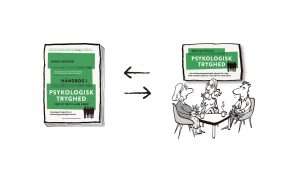
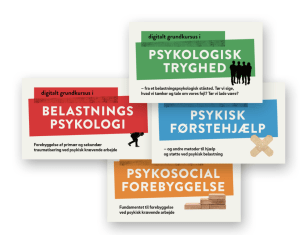
Handbook of Psychological Safety is based, in both form and content, on the department’s digital introductory course in psychological safety. The book serves as a unifying starting point and a standalone supplement to the course, enabling you to practise psychological safety alongside the colleagues and managers with whom you carry out your core tasks on a daily basis. Some people start with the book – others with the course.

…or find out more by writing to Nynne at nynne@belastningspsykologi.dk, who is the department’s ‘Face of the Month’ – see the end of the newsletter.

Testimonies from the north-western corner of the country in North Jutland to the south-eastern corner in Rødby

The basic digital course on psychological safety has already been rolled out to workplaces across the country. This is the case both within local authorities – for example, in Frederikshavn Municipality and the inter-municipal North Jutland Emergency Services – and in the regions – for example, at Kofoedsminde in Rødby and across the country in, for instance, the many institutions run by the Prison and Probation Service. Private workplaces have also discovered the course – for example, the staff at Odsherred Veterinary Hospital.


We recently asked them about their experiences of working with the safety course and were simply delighted when the feedback we received included comments such as: ”The ’do-it-yourself pack’ is really easy to use”, ”One of the major advantages of the course is that, being digital and structured in modules, it offers us a high degree of flexibility, making it possible to roll it out in various ways across the Prison Service over time.”, ”… we’re not quite there yet, but the course has got us off to a good start”, ”The course has given us a shared basic understanding … and a common language”, ”…for example, we now spend 5 minutes every day … discussing a hypothetical dilemma”, ”We’ve got much better at putting forward proposals” and ”Everyone took an active part and shared a laugh at the humorous and relatable elements in the short films”.

Faces at the department: A keen eye for implementation

Nynne Kjøller-Svarre has been part of the team since the institute’s inception – first as an intern whilst training as an Emergency Preparedness and Risk Manager, and later as a prevention consultant. Her role today is primarily to advise and guide organisations on the implementation of our digital foundation courses – including the Foundation Course in Psychological Safety, which is the course that Handbook of Psychological Safety is based on and interacts with, in both form and content.


“Our Basic Course in Psychological Well-being has been very well received in workplaces across a wide range of professions. Veterinarians, prison staff, social care workers, administrative staff, nurses and firefighters have all returned with positive stories about a new shared language, valuable reflections, laughter and a sense of recognition. This tells me that psychological safety in the workplace is absolutely central to well-being and job satisfaction.


I myself feel a sense of job satisfaction when workplaces manage to crack the code on implementation and make the theory a firm and integral part of their everyday lives, where everyone recognises their important contribution to a sustainable working community. My greatest success is when organisations show us how they are applying the individual courses, models and strategies, which are often the result of meaningful conversations where everyone gains a clear understanding of their roles, responsibilities and options for action.”  

Book a course demonstration

A demo gives you the chance to take a closer look at the various digital group courses that form part of THE PREVENTION HOUSE.

Didn’t you get a chance to read our latest newsletter?

…so don’t worry. You can find it by clicking on the link below.